When Structure Meets Relationship: Rethinking How We Partner with Sibrecht Diender
with Sibrecht Diender, Founder at Yellow Everest
What if a contract could be built on trust instead of fear? In this episode of the Love Not Fear podcast, Tine Bieber sits down with Sibrecht Diender, relational contracting expert, founder of Yellow Everest and member of the Vested Board of Advisors, to talk about what happens when structure meets relationship. Sibrecht explains how relational contracts move business partners away from power games and risk shifting toward co-creating a shared vision, and why the way we write our agreements says a lot about our culture. Together they explore trust, transparency, governance and what it really takes to keep a partnership alive for the long term.
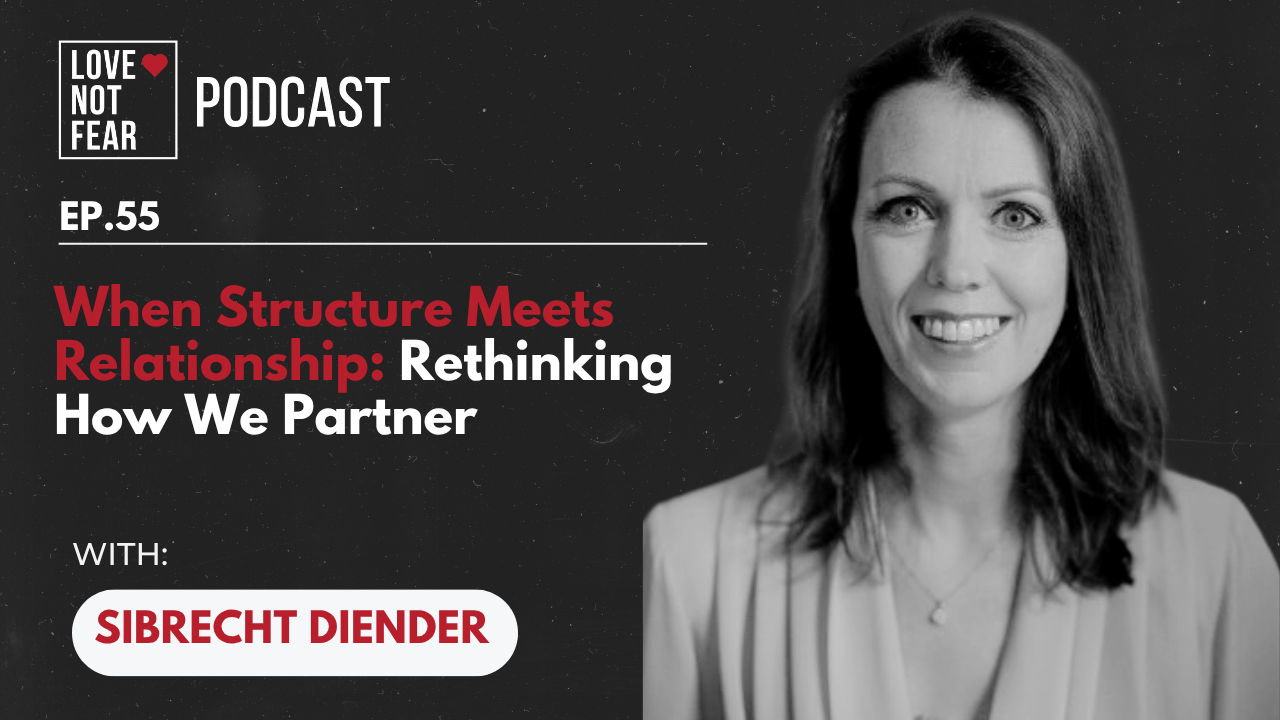
When Structure Meets Relationship: What Sibrecht Diender Teaches Us About Partnering on Trust
Most organizations say they value partnership. They write it into their mission, put it on their walls and talk about it with customers and suppliers. But when a crisis hits, what do we actually fall back on? Very often it is a contract written to protect one side from the other.
In this episode of the Love Not Fear podcast, host Tine Bieber talks with Sibrecht Diender, founder of Yellow Everest, certified Vested coach and member of the Vested Board of Advisors. Their conversation explores a powerful idea: if we want to walk our talk on culture, it has to show up in how we enter relationships, including the legal ones.
From negotiation tactics to a shared goal
Sibrecht started her career in procurement. She loved the chance to collaborate internally and with suppliers, but she also noticed that procurement had turned into “a play from who has the biggest power over the other to get things done.” It never felt right to her, even if she did not yet know the alternative.
That changed when she came across the Vested methodology. Suddenly the thing she had been searching for had a name: relational contracting. As she puts it, “You can actually have collaborations with your suppliers from a procurement standpoint and focus on the things that you need to do together instead of focusing on each other.”
Relational versus transactional
Most contracts, Sibrecht explains, are transactional, designed to shift as much risk as possible to the other side, depending on who holds more power.
A relational contract works differently. Both parties co-create it, starting with a statement of intent: a shared vision, desired outcomes, social norms and the behaviors they commit to. “If anything happens,” Sibrecht says, “then you will always go back to your statement of intent.” It is still legally enforceable, but “it talks about how you want to do business together instead of how you want to, well, safeguard your own assets.”
Tine connects this directly to the heart of the podcast. A risk minimizing, scarcity driven mindset comes from fear. Relational contracting asks a different question: how can we make the pie bigger for everyone involved?
Trust and transparency are not optional
That shift is not easy. “Suddenly they have to be very, very transparent and they have to trust each other,” Sibrecht says. “So you need to have trust and be willing to be transparent with each other.”
And this is where culture comes in. “Fear is often a driver of not being transparent,” she explains, and organizational cultures can either stimulate or restrict that transparency. Changing a fear driven mindset is a precondition for success.
Who sits at the table
A relational contract is built by a core team from each organization, often paired into “couples” with the same expertise: finance with finance, legal with legal. A steering committee of the people who will sign the contract approves each step, so there are no surprises at the end.
Tine points out what this does to accountability. When you sit at the table and help create the agreement, you cannot just point fingers. It becomes, in her words, an adult to adult relationship.
Most challenges start inside
Writing “Successful Relational Contracting” with her colleague Bonnie Keith revealed a pattern: most challenges happen in the internal alignment phase and originate in organizational structures. When each silo has its own targets, partnering with an outside company becomes extremely difficult.
A playbook, not a drawer document
Success can mean shared sustainability goals or, very often, money. But not in the usual sense. Instead of looking at price, partners look at the total cost of ownership together, which means buyers also have to open up their own numbers. That is scary at first. “But once they start to do that, they actually see that there’s so much potential,” Sibrecht says. People stop acting like buyer and supplier and start acting like colleagues. “That’s where you see the magic happen.”
Because business keeps changing, the contract has to as well. “The contract itself should function more like a playbook than a contract,” Sibrecht explains. It should not be “something that you put in a drawer.” The legal framework stays stable, while the schedules covering scope, metrics, pricing and governance are updated together as reality changes.
Tested by crisis
COVID put these contracts to the test. Sibrecht describes a telecom company in Belgium whose outsourced technicians suddenly could not enter people’s homes. Instead of fighting over who would pay their salaries, the partners sat down to figure out how to get those people back to work and adding value. Because the technicians were paid for outcomes, not visits, the partners could get creative. “It’s amazing to see how creative people become if they’re feeling that it’s a joint responsibility,” she says.
Keeping it alive
The hardest part, Sibrecht admits, is making sure the relationship stays alive. The first generation of people knows the contract firsthand because they built it. By the second or third generation, it starts to crumble, not because people are unwilling, but because they inherited it. Her advice is to run a lighter refresh with the new team. “At least it makes it something that they own again because they created it. And that’s the best onboarding you can have.”
Key takeaways
- Contracts reflect culture. If trust is a value, it belongs in how you write your agreements.
- Start from a shared statement of intent, not from protecting yourself against the other side.
- Transparency, including about your own costs, unlocks value that power games never will.
- Ownership fades over time. Regular health checks and refreshes keep a partnership alive.
Listen and Connect
Sibrecht Diender is the founder of Yellow Everest, a consultancy based in the Netherlands that helps organizations build strategic, trust based business partnerships. She has close to two decades of experience in procurement and supply chain, including roles in the energy and high tech sectors. Sibrecht has been a certified Vested coach since 2016 and has served on the Vested Board of Advisors since 2020. She is the co-author, with Bonnie Keith, of Successful Relational Contracting: Preparing for Business-to-Business Collaboration (Palgrave Macmillan, 2025). You can find her on LinkedIn.
For more conversations like this, visit lovenotfear.com and subscribe to the Love Not Fear Podcast wherever you listen.